

DTF Transfers: How Small Shops Can Launch With Less Risk
Starting an apparel business does not require a full production floor, a room full of specialty equipment, or a huge inventory of finished shirts. With DTF transfers, we can test designs, accept small custom orders, and expand into new garment types while keeping upfront risk far more manageable.
That flexibility matters because customers rarely order in neat, predictable batches. One day it is 12 staff shirts for a local café, the next it is a single birthday hoodie, then a rush order for 30 team tees. Direct-to-film transfers give early-stage decorators a practical way to say yes more often without committing to screens, weeding vinyl, or stocking every design in every size.
The opportunity is substantial, but the workflow still has to be disciplined. Grand View Research estimates the global print-on-demand market at $13.1 billion in 2026, with apparel remaining a major category. Read the market report for the broader context, then focus on the part we can control: delivering dependable decorated apparel from the first order onward.
Why DTF Works So Well for Early-Stage Apparel Shops
DTF works because it separates printing from pressing. We can order ready-to-apply designs, keep a focused range of blank garments on hand, and decorate an item only after the customer has approved the order.
Unlike screen printing, which is often most economical for larger repeat runs, direct-to-film transfers are well suited to small quantities, full-color artwork, and mixed designs. Unlike heat transfer vinyl, they do not require cutting and weeding each color layer. That saves hands-on labor and reduces the chance of a simple production task becoming a bottleneck.
| Method | Best For | Main Strength | Main Tradeoff |
|---|---|---|---|
| DTF transfers | Small to medium runs | Full color on many fabrics | Requires accurate pressing |
| Screen printing | Large repeat orders | Low unit cost at volume | Setup and color limitations |
| HTV | Simple names and numbers | Easy personalization | Weeding takes time |
| Sublimation | Light polyester items | No hand feel | Not for cotton or dark garments |
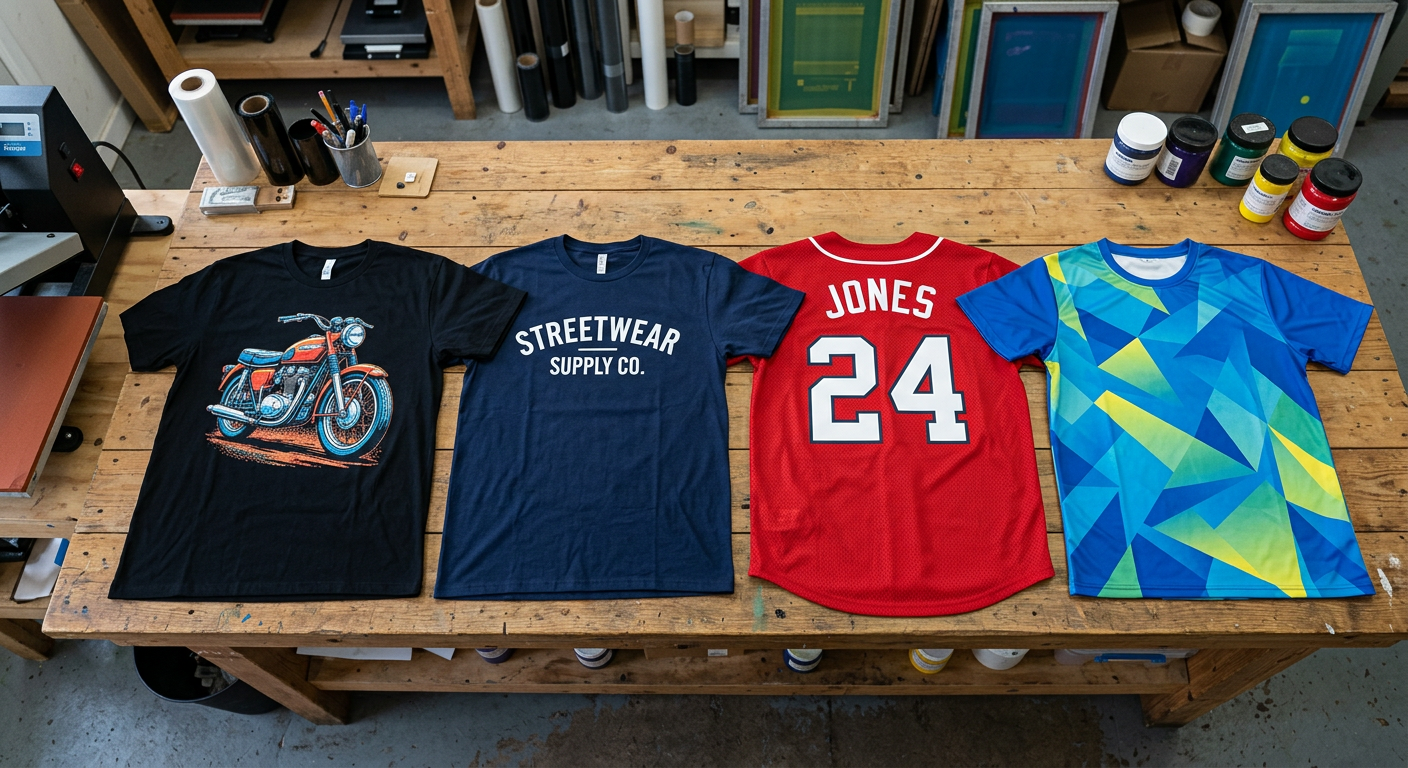
DTF is especially useful for cotton, polyester, blends, and many performance fabrics. A quality transfer includes a printed color layer, white ink support where needed, and adhesive powder that bonds under heat and pressure. The result should be vivid, flexible, and durable when the garment is pressed correctly.
The Day-One DTF Setup We Recommend
For a new shop, the best launch plan is simple: begin with a reliable heat press, a small blank-garment selection, strong artwork standards, and outsourced transfers. We do not need to buy a DTF printer before proving that customers will purchase our designs.
Start With the Equipment That Protects Quality
A dependable heat press is the core tool. It needs even pressure across the platen and a temperature that is reasonably accurate. A press that runs cool in one corner or provides inconsistent pressure can cause lifting, incomplete adhesion, and unhappy customers, even when the transfer itself is excellent.
Keep a lint roller, heat-resistant tape, parchment or a cover sheet, a ruler, and a simple alignment guide nearby. These low-cost tools help us produce repeatable placement, which is one of the clearest differences between a hobby project and a professional order.
Limit Blank Options at First
We recommend starting with a short, intentional blank catalog. For example, choose one dependable unisex T-shirt, one premium tee, one hoodie, and one performance shirt. Offer a few proven colors before adding every possible garment, shade, and fit.
This approach makes pricing, reorders, photography, and customer communication much easier. It also prevents us from tying up cash in blanks that may not move for months.
Establish File Rules Before Customers Upload Art
Most transfer problems begin before the press is even turned on. Ask for high-resolution PNG files with transparent backgrounds when possible, and make sure artwork is sized to the final print dimensions.
For professional results, use files in RGB or CMYK color mode and avoid sending artwork with indexed, grayscale, or Pantone color settings when the supplier does not support them. Arizona Ink’s DTF file and ordering instructions explain accepted formats and practical setup requirements, while its DTF printing vocabulary guide helps new decorators understand terms such as cold peel, pre-press, and final press.
A Simple DTF Pressing Process That Builds Customer Trust
Consistent pressing is what turns a good transfer into a dependable finished product. We should use the supplier’s instructions first, then document our proven settings for each blank style and keep those notes at the press.
For standard DTF transfers, Arizona Ink recommends a 315°F press with high pressure for 15 seconds, a complete cool-down before peeling, and an optional five-second finishing press. Exact settings can vary by transfer and garment, so we should always test a sample before producing a paid order.
Pre-Press the Garment
Pre-pressing removes wrinkles and moisture. It also gives us a flatter surface, which helps the transfer receive even pressure across fine lines, solid color areas, and small details.
Align and Secure the Transfer
Use a ruler or alignment tool instead of relying on eyesight alone. For repeat designs, measure down from the collar and record the placement so the next shirt matches the first one.
Press, Cool, Peel, and Finish
Apply the required heat and pressure, then let the film cool fully if it is a cold-peel transfer. Peel steadily rather than yanking the carrier sheet, inspect the design, and complete a finishing press if the transfer instructions call for one.
If edges lift, do not assume the transfer is defective. Check platen temperature, pressure, moisture, garment texture, and whether the design had enough time to cool. A small test press can save an entire order.
How We Would Price the First DTF Orders
Early-stage shops should price for labor, spoilage, overhead, and profit, not just the cost of the blank and transfer. A shirt that looks profitable on paper can quietly lose money once we add design cleanup, customer messages, pressing time, packaging, and a replacement for occasional mistakes.
Use this straightforward formula:
Selling price = blank garment + transfer + labor + overhead allowance + profit
For example, if a blank costs $4.50, the transfer costs $3.25, labor and packing total $4.00, and we reserve $1.25 for overhead and mistakes, the true cost is $13.00. Pricing that shirt at $16 leaves almost no room to grow. Pricing it at $24 to $28 may be more realistic, depending on garment quality, artwork size, turnaround, and local competition.
We should also charge separately for design work when a customer sends a blurry logo, asks for background removal, or needs an idea turned into print-ready art. Free art cleanup feels generous until it consumes an afternoon.
Use Gang Sheets to Improve Margin Without Raising Prices
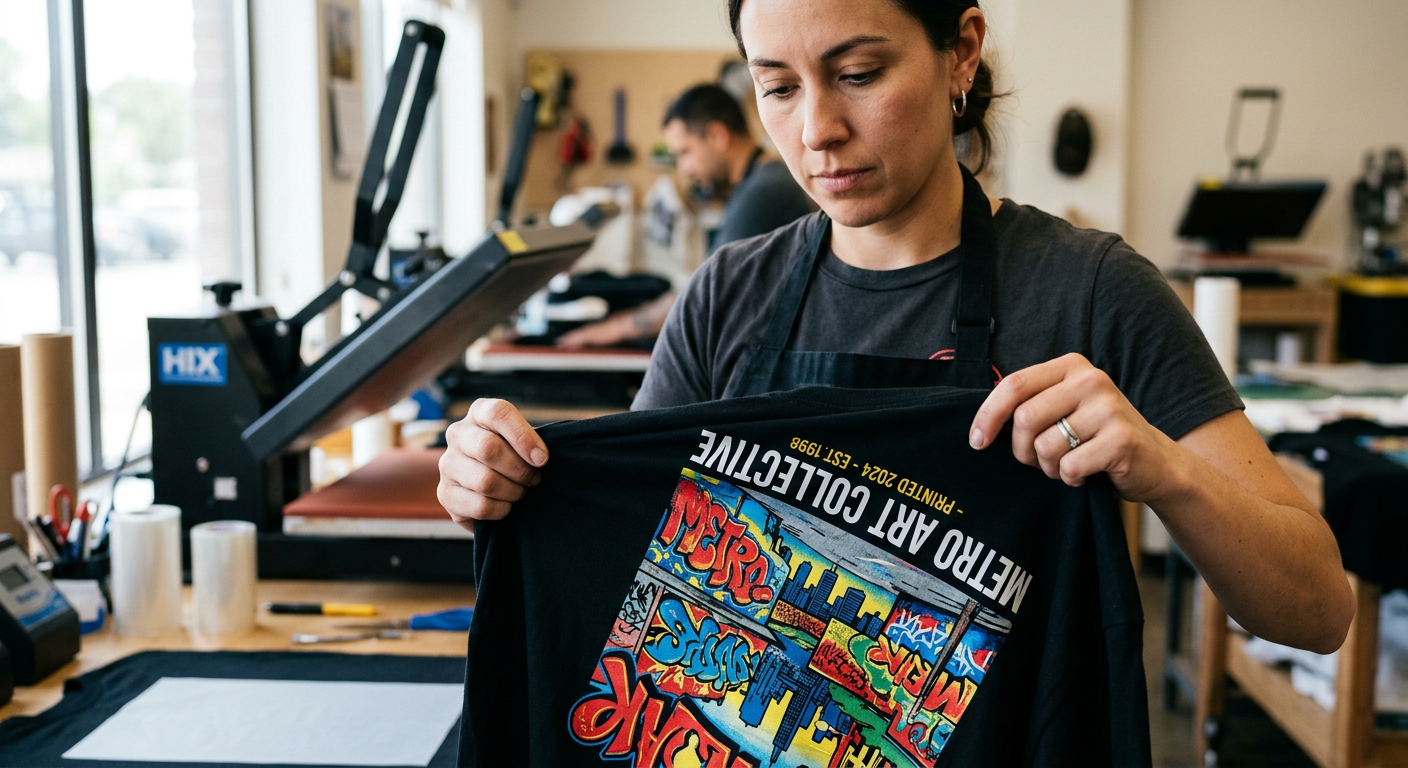
Gang sheets can lower the effective cost of each design by combining multiple graphics on one sheet. We can fit left-chest logos, sleeve prints, youth designs, back graphics, and repeat artwork together, then trim and press each piece as needed.
The key is to gang only designs we genuinely expect to use. Do not fill a sheet with speculative graphics simply because there is open space. A better approach is to combine a confirmed customer order with evergreen shop assets, such as our logo, popular school-spirit graphics, or standard workwear placements.
For shops that have enough verified artwork ready to print, Arizona Ink offers DTF transfer ordering alongside multiple gang-sheet sizes. We should compare sheet capacity with our real order volume, not assume that the biggest sheet always delivers the best value.
When DTF Is Not the Best Choice
DTF is versatile, but it is not automatically the right answer for every job. Choosing the right method protects both our margins and the customer’s finished product.
For a large order with one or two solid ink colors, screen printing may offer a lower unit cost and a lighter print feel. For white or light polyester garments and coated drinkware, sublimation can deliver a permanent, no-hand-feel result because the dye becomes part of the substrate. For simple names, jersey numbers, or one-color personalization, HTV may remain the quickest option.
We should also distinguish DTF from UV DTF. Standard DTF is designed for fabric and requires a heat press. UV DTF is a peel-and-apply option for hard, nonporous surfaces such as tumblers, glass, plastic, and metal, so it serves a different product category entirely.
Common Questions About DTF Transfers
How long do DTF transfers last on shirts?
A properly applied quality transfer can withstand repeated laundering, but longevity depends on the transfer, garment, press settings, and care habits. We recommend washing garments inside out in cold water, avoiding harsh bleach, and using low heat or air drying when possible.
Can we apply DTF transfers with a household iron?
A household iron can work for experimentation, but it is not ideal for customer orders. Irons do not provide consistent temperature or even pressure, which makes adhesion less reliable than a dedicated heat press.
Do DTF transfers work on dark garments?
Yes, DTF is well suited to dark garments because the process can include a white ink layer beneath the color artwork. That support layer helps bright colors remain visible on black, navy, maroon, and other dark blanks.
How small can DTF details be?
Fine details can print well, but extremely thin lines and tiny isolated elements are more likely to fail during production or application. We should simplify fragile artwork, slightly thicken thin strokes, and test small designs before selling them at scale.
Should we buy a DTF printer right away?
Usually, no. Outsourcing transfers lets us validate demand and build sales before taking on printer maintenance, ink management, humidity control, powder handling, curing equipment, and daily production responsibilities.
Can we store DTF transfers for later use?
Yes, when they are kept flat, dry, and protected from excessive heat, moisture, and dust. Store transfers in a clean sleeve or box and label them by customer, design, size, and order date to avoid costly mix-ups.
Build the First Order Before Building the Whole Shop
DTF transfers give us a low-friction way to create professional custom apparel while we learn what customers actually want. The smartest first move is not chasing every product category. It is building a repeatable system for artwork, blanks, pressing, quality control, and pricing.
Start with a few clear offers, test every blank and design combination, and keep records of what works. Once we can deliver consistent shirts at a profit, scaling becomes a business decision instead of an expensive guess.
Put Your First DTF Workflow to Work
Ready to move from mockups to finished apparel? Browse Arizona Ink for ready-to-press transfers, gang-sheet options, and specialty decoration choices that help us fulfill small custom jobs or build toward higher-volume production.
Order a sample run, document your press settings, and make your first offer easy for customers to understand. Reliable execution is what earns repeat orders.