

A tumbler, candle jar, or product package can become a branded retail item in minutes, without a heat press or a large production setup. That is why UV DTF stickers make a strong early product for apparel decorators, crafters, print shops, and online sellers who want to add hard-surface customization without taking on a new equipment category.
The opportunity is larger than a single trendy drinkware design. The U.S. Census Bureau reported that retail e-commerce sales reached $347.3 billion in the third quarter of 2026, representing 17.9% of total retail sales. For a young customization business, that makes small, easy-to-ship branded goods worth testing alongside shirts and apparel orders. U.S. Census Bureau (census.gov)
Where UV DTF Stickers Fit in a Custom Product Business
UV DTF transfers are best for smooth, hard items that need durable, full-color decoration without heat. They are a practical complement to apparel transfers, not a substitute for them.
| Method | Best surfaces | Equipment needed | Best use |
|---|---|---|---|
| UV DTF | Glass, metal, sealed wood, plastic | None for application | Tumblers, packaging, gifts |
| DTF | Cotton, polyester, blends | Heat press | Shirts, hoodies, bags |
| Sublimation | Polyester and coated blanks | Heat press | Mugs, performance apparel |
| Adhesive vinyl | Flat, simple surfaces | Cutter and weeding tools | Names, simple lettering |
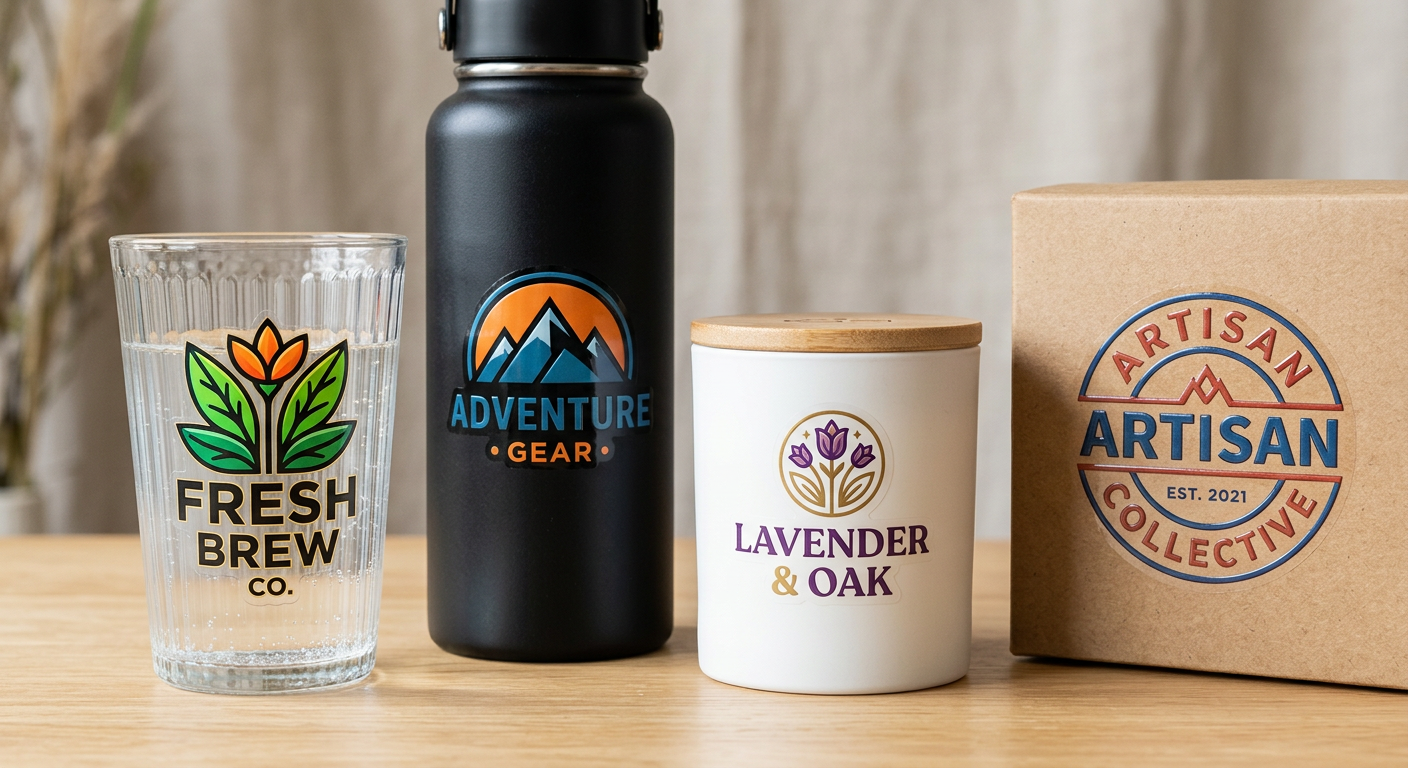
With UV DTF, the printed design has an adhesive layer that bonds to the item after application. The result is typically glossy and slightly raised, giving logos and artwork more presence than a flat paper label. Arizona Ink describes its UV DTF transfers as waterproof and scratch-resistant, with no heat press required for application. UV DTF sticker transfers (arizonaink.com)
The products that make sense first
We recommend beginning with products customers already understand and can buy as a gift, business giveaway, or add-on. A 16-ounce glass can, stainless tumbler, acrylic keychain, candle vessel, product box, or water bottle gives you a clear starting point.
Avoid building a catalog around every possible blank. Early-stage shops make faster decisions when they choose two blank categories, create several coordinated designs, and photograph them consistently. A collection of western florals, team-spirit icons, salon logos, or realtor closing gifts is easier to market than a random pile of one-off decals.
How to Apply UV DTF Transfers Cleanly
A clean, deliberate application process matters more than speed. Most failures come from contaminated surfaces, rushed placement, or trying to use decals on surfaces that are too textured or flexible.
Prepare the blank before touching the transfer
Wipe the application area with isopropyl alcohol and let it dry fully. Avoid applying over dust, skin oils, moisture, or cleaning-product residue, because even a premium adhesive cannot bond properly through contamination.
Use blanks with a smooth, firm surface whenever possible. Glass, powder-coated metal, hard plastic, acrylic, sealed wood, and ceramic are common choices. Raw wood, silicone, heavily textured powder coating, soft rubber, and sharp compound curves should be tested before you offer them for sale.
Position once, then press with purpose
Peel the transfer from its backing carefully, hold it by the edges, and hover above the blank until you are confident in the placement. Once adhesive touches the surface, repositioning can distort fine lettering or weaken the bond.
Press the design from the center outward using firm, even pressure. Work slowly around letters, tiny details, and outside edges to push out air. Then remove the top carrier film gradually at a low angle, checking that small details remain attached before continuing.
For artwork setup, use a transparent high-resolution PNG or a vector file when available. Arizona Ink accepts PNG, TIFF, EPS, and AI files in RGB or CMYK, while noting that Pantone and grayscale color spaces are not accepted. Its file preparation and order instructions are useful for avoiding preventable artwork delays. (arizonaink.com)
A Day 3 Product Plan for an Early-Stage Shop
The fastest way to stall is to create too many designs before confirming what buyers want. On day three of building your product line, we would focus on a controlled product test that gives you usable sales data without tying up cash in inventory.
Build one focused micro-collection
Choose one customer group and one use case. For example, a local salon could offer logo drinkware for stylists, appointment thank-you gifts, and retail display jars. A school-spirit seller could build water bottles, locker tags, and teacher gifts around the same mascot colors.
Create 12 designs across three mini themes. Include four name-ready designs, four business-logo layouts, and four seasonal or niche graphics. This gives shoppers enough choice without making your listing photos, ad copy, and fulfillment process harder to manage.
Test two blank types and three price points
Start with two blanks, such as glass cans and acrylic keychains. Then test a low-ticket item, a core product, and a small bundle. A simple structure could look like this:
- Keychain with a name decal
- Glass can with a full-wrap style logo or artwork
- Gift bundle with a decorated glass can and matching keychain
This format teaches you what customers value. If individual keychains get attention but bundles generate the best revenue, you know to build future collections around giftability. If logo orders outperform pre-made artwork, prioritize business outreach and repeat-order systems.
Capture content that proves the finish
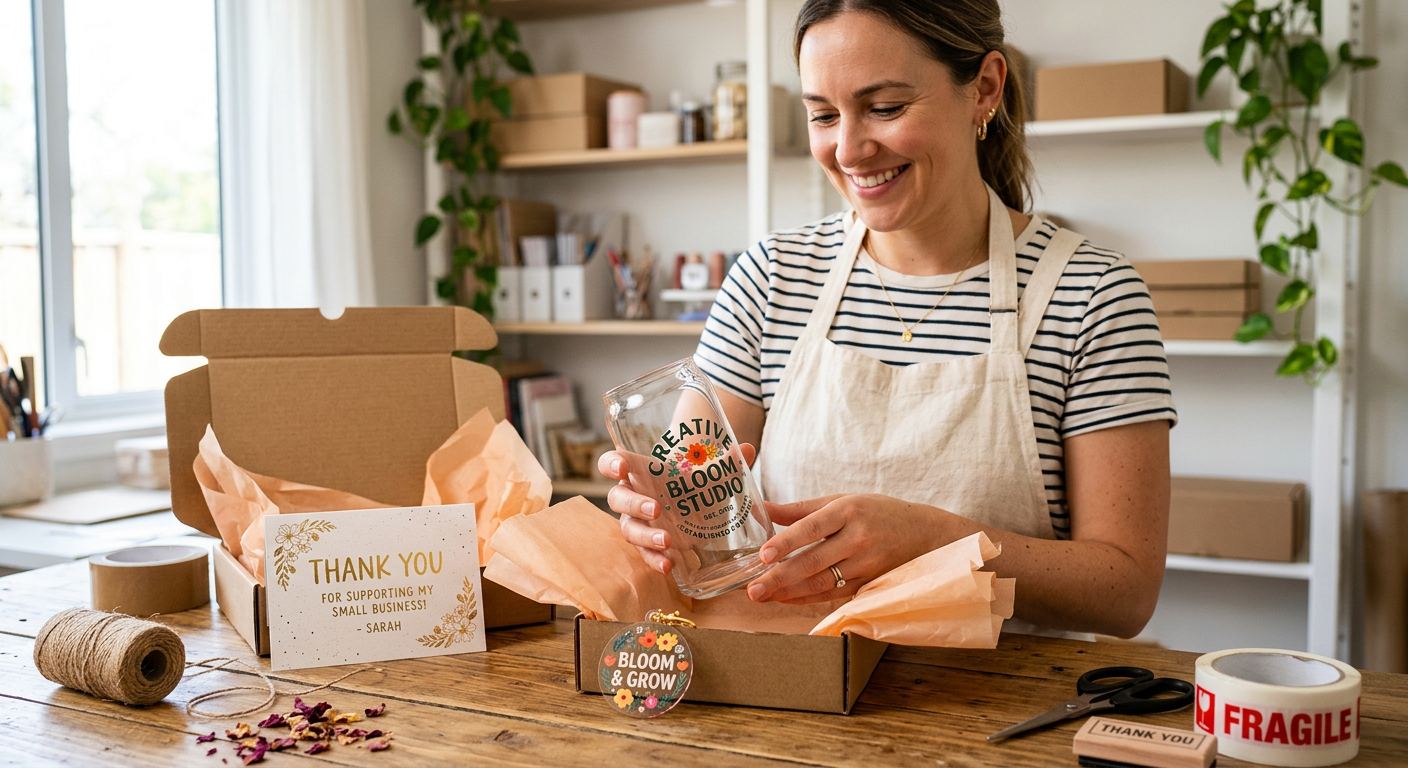
For each design, shoot three views: a full product shot, a close-up that shows the glossy raised finish, and a short application clip. The last one is especially useful because it answers the buyer’s unspoken question: “Will this look professional when I receive it?”
Small businesses are not a niche audience. The U.S. Small Business Administration reported 36.2 million small businesses in the country in its 2025 profile, so products that help local companies present a consistent brand deserve a place in your offer. U.S. Small Business Administration (advocacy.sba.gov)
Make UV DTF an Add-On, Not Just a Standalone Product
The easiest first sale may come from customers already buying something else from you. UV DTF works well as an order bump because it turns existing artwork into an additional item with little design redevelopment.
A custom T-shirt order can become a matching water-bottle order for a team. A business apparel order can add logo decals for storefront jars, employee tumblers, packaging, or equipment labels. For fabric goods, use DTF transfers for garments rather than UV decals, which are designed for hard surfaces. (arizonaink.com)
If you also sell mugs, polyester apparel, or coated hard goods, understand where sublimation fits. It requires heat and works with suitable coated items or polyester materials, while UV DTF gives you a no-heat decoration option for a broader range of hard blanks. Sublimation transfer options (arizonaink.com)
Protect Your Brand and Your Customer Relationships
Custom printing is not permission to reproduce every logo, character, or phrase a customer sends. We should treat artwork ownership as part of the order process, especially when we market products publicly or create designs for resale.
The U.S. Patent and Trademark Office explains that a trademark can be a word, phrase, symbol, design, or combination that identifies the source of goods or services. Ask customers to confirm that they own or are authorized to use submitted artwork, and avoid using recognizable third-party marks in sample listings unless permission is clear. USPTO trademark basics (uspto.gov)
Frequently Asked Questions
How long do UV DTF stickers last on tumblers?
Durability depends on the blank, surface preparation, application quality, and how the item is used. Apply transfers to clean, smooth surfaces, press all edges firmly, and test your chosen blanks before making long-term durability promises to customers.
Can UV DTF stickers go in the dishwasher?
Some sellers use UV DTF on drinkware intended for regular washing, but hand-washing is the safer recommendation unless you have tested that exact blank, transfer, and application process. Do not assume every decal and tumbler combination will perform the same way.
Do we need a heat press for UV DTF transfers?
No. UV DTF is applied with pressure by hand, which makes it appealing for crafters and shops that already have apparel equipment but do not want another production step for hard goods.
Can UV DTF be used on shirts or hats?
No, it is not the right method for fabric. Use garment-ready DTF transfers for shirts, hoodies, totes, and many fabric accessories because they are designed to be heat applied and flex with the material.
What file should customers send for a UV DTF order?
A transparent PNG is often the simplest file for customers, while vector formats such as AI or EPS are excellent for sharp logo artwork. Confirm the print size before ordering, since a low-resolution file cannot be improved simply by enlarging it.
Is UV DTF better than vinyl decals?
It depends on the job. Vinyl is still useful for simple text, single-color shapes, and certain curved applications, while UV DTF is a stronger choice for detailed, full-color art with a glossy raised appearance and no weeding step.
Put Your First UV DTF Collection Into Production
We can help you move from a product idea to ready-to-apply transfers without committing to large equipment purchases or oversized quantities. Browse Arizona Ink to order full-color UV DTF sticker transfers, upload your artwork, and build a small test collection around the products your customers already buy.
Build Proof Before You Build Scale
UV DTF stickers give a small shop a low-friction way to enter hard-goods customization, test branded product ideas, and create higher-value add-ons from artwork already in its workflow. Start with a focused collection, use dependable blanks, document the application process, and let actual orders guide the next designs you produce.
The strongest product line is rarely the biggest one. It is the one that solves a clear customer need, looks polished in photos, and can be repeated profitably without creating production chaos.